
The most direct way to earn SOL is to stake it. On 1 October 2026, StakingRewards.com showed a Solana reward rate of 5.02%, and top validators on Helius listed total APY between 4.61% and 5.21%. Banana Gun adds two more routes: a revenue share and Banana Bonus cashback.
You pick between them by what you hold and how long you can leave it. This page lays out each option with its current numbers, its source and its catch.
Staking figures below were read on 1 October 2026 and move constantly. Treat them as a snapshot.

How much can you earn by staking SOL?
Native staking means you delegate your SOL to a validator and receive rewards for helping secure the network. Solana's own learn page says staking earns "approximately 5-7% annual rewards" (solana.com, read 1 October 2026), a static editorial range.
The live numbers sit lower. StakingRewards.com showed a reward rate of 5.02% with 69.38% of SOL staked, updated 19 hours before it was read on 1 October 2026.
Validators differ. The Helius validator table, built on StakeWiz data and read on 1 October 2026, lists the top 10 by stake with total APY from 4.61% to 5.21%.
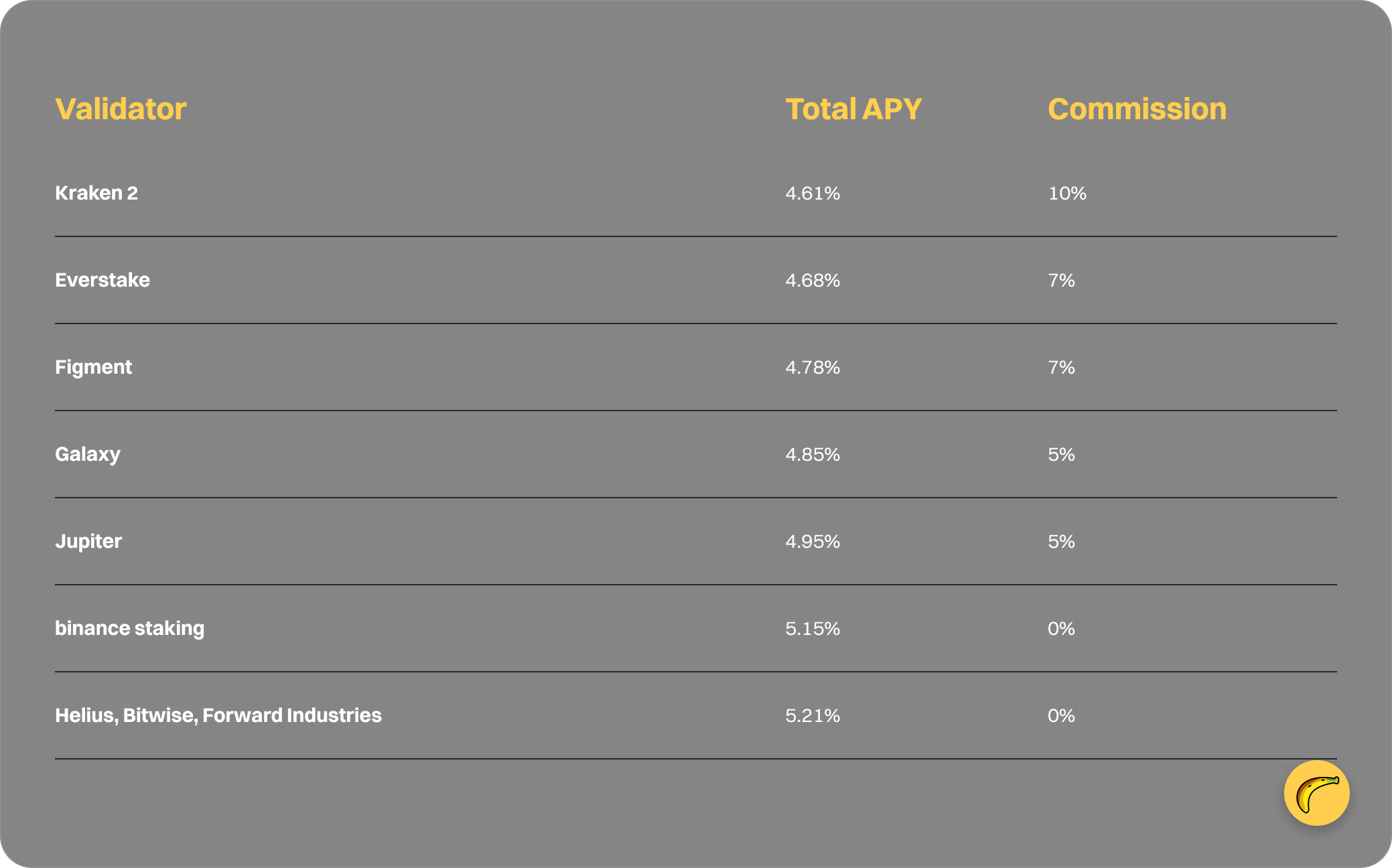
Commission is the fee a validator keeps from your rewards. Solana's docs say returns depend on the inflation rate, the total SOL staked on the network, and a validator's uptime and commission.
The top of the table is not the whole market. StakeWiz's cluster stats API returned an average APY of 3.79% across all validators on 1 October 2026, and that average includes weak ones. The gap between that average and the best validator on the Helius table is 1.42 percentage points.
At the 5.02% rate, 10 SOL would earn about 0.502 SOL over a year if the rate stayed fixed, and it will not.
What is the catch with native staking?
Your SOL is not free the moment you want it. Stake changes state at epoch boundaries, and the Solana docs say an epoch is approximately 2 days long. Un-delegated stake is "deactivating" or "cooling down" and cannot be withdrawn until it is inactive.
The docs also cap movement across the network: no more than 25% of the total active stake can be activated or deactivated in a single epoch.
A trader who needs SOL for a position within hours should not rely on a stake account. Keep the trading balance unstaked and stake only what you can leave alone.
Is liquid staking better than native staking?
Liquid staking swaps your SOL for a token that accrues the staking yield, so the position stays usable in DeFi. It is a different trade, not a strictly better one.
Jito's staking page showed 4.87% APY for JitoSOL on 1 October 2026, with 1 JitoSOL worth about 1.304 SOL. Jito's own description says JitoSOL accrues staking and MEV rewards and can be used in DeFi.
For mSOL, Marinade's API returned a 30-day APY of 5.31% for the window 1 September to 1 October 2026. Marinade's home page headline for its native staking product was 5.05% APY on the same day.
Those are two different products with two different numbers, so compare them under their own labels. A 30-day figure covers a short window.
Liquid staking adds a smart contract and a token price between you and your SOL. Check the exact exit terms for JitoSOL or mSOL on the provider's page before depositing; this page has not verified them.
How does the Banana Gun revenue share work?
Banana Gun's docs say $BANANA token holders can claim rewards on the dashboard, and those rewards come from bot revenue, 40% after referrals. The docs state four conditions:
- You need to own 50 $BANANA to be eligible.
- Only tokens that are not locked accrue rewards.
- You can claim without paying for gas once your revenue has accrued to 0.1 ETH or 0.1 SOL.
- On Solana you can only claim in SOL. On EVM chains you can claim in ETH or $BANANA.
The docs list no per-token earnings rate, so there is no APY to quote. They also say $BANANA claimed through rewards is bought back from the market.
This route needs a $BANANA position first, which makes it an investment in the token rather than a way to earn with the SOL you already hold. Its value moves with the token and with bot revenue.
Claims happen at dashboard.bananagun.io. The docs link the rewards page there for revenue share and referral rewards. The claim screen is not documented label by label, so follow the on-screen prompts.
What is Banana Bonus cashback?
Banana Bonus pays you a small percentage of your trading volume back in $BANANA. The docs say the cashback equals the fees you paid in dollars multiplied by a number between 0.05 and 1, which Banana Gun adjusts to manage emissions.
That multiplier is set by Banana Gun, and the live value is not published in the docs. Any figure you see for what you will earn is a guess until you read your own balance.
The docs give an illustration: $10,000 of volume at a 0.75% average fee is $75 in fees, and at a multiplier of 0.02 that is $1.50 of cashback. Those numbers are illustrative, not a live rate, and the 0.02 in that example sits below the 0.05 floor the same docs state, so read the example for the method, not the figure.
You earn on manual buys, sells and limit orders. To check what you have earned, open the Banana Gun main menu and tap Banana Bonus. The same menu is where you claim, with a minimum of 5 $BANANA.
Two limits matter. The reward arrives in $BANANA, not SOL, so you only hold SOL after you swap it yourself. And you earn it by paying fees: the multiplier tops out at 1, so the rebate cannot exceed the fees you paid.
Whether Banana Bonus applies on Robinhood Chain is not documented. Check inside the bot if you trade there.
Can you earn SOL by trading it?
Sometimes, and it is the one option here with no rate at all. A trade can grow your SOL or shrink it, and every round trip pays fees on both sides. Banana Gun charges 1% on Solana per docs.bananagun.io, so a buy and a sell cost 2% before slippage.
Our guide to reading a token contract before you buy covers what to check first.
Treat trading capital as money you can lose, and keep it separate from stake you are earning yield on. If you want to see the tools traders compare, start with the best Solana trading bots right now.
Which option fits you?

If you hold SOL and want it to work quietly, stake it natively with a validator that charges low commission. If you want to stay flexible, look at a liquid staking token.
If you already trade on Banana Gun, Banana Bonus costs you nothing extra to check. Revenue share is a bet on the token, so size it like one.
Frequently asked questions
What is the lowest-risk way to earn SOL?
No option here is without risk. Native staking is the simplest, since you keep SOL and choose a validator, but your stake is locked during the cooldown and validator quality varies. Liquid staking and trading add contract and price risk.
How much SOL can you earn by staking 10 SOL?
At StakingRewards' 5.02% rate on 1 October 2026, about 0.502 SOL over a year. At the 3.79% network average across validators, about 0.379 SOL. Rates change as the network does.
How do you claim Banana Gun rewards on Solana?
Go to the Banana Gun dashboard at dashboard.bananagun.io. You need 50 $BANANA to be eligible, and on Solana revenue-share claims pay out in SOL. Gas-free claims start once your accrued revenue reaches 0.1 SOL.
Does Banana Gun pay you in SOL?
The revenue share pays Solana claims in SOL. Banana Bonus cashback pays in $BANANA, which you can swap yourself. Both depend on conditions in the docs, including a 50 $BANANA holding for revenue share and a 5 $BANANA minimum claim for cashback.
Is Banana Bonus the same as the revenue share?
No. Revenue share comes from holding $BANANA and is paid from bot revenue. Banana Bonus comes from trading volume and is paid in $BANANA. The docs say Banana Bonus tokens also receive revenue share.
Start trading with Banana Gun in the Telegram bot or on Banana Gun Pro.